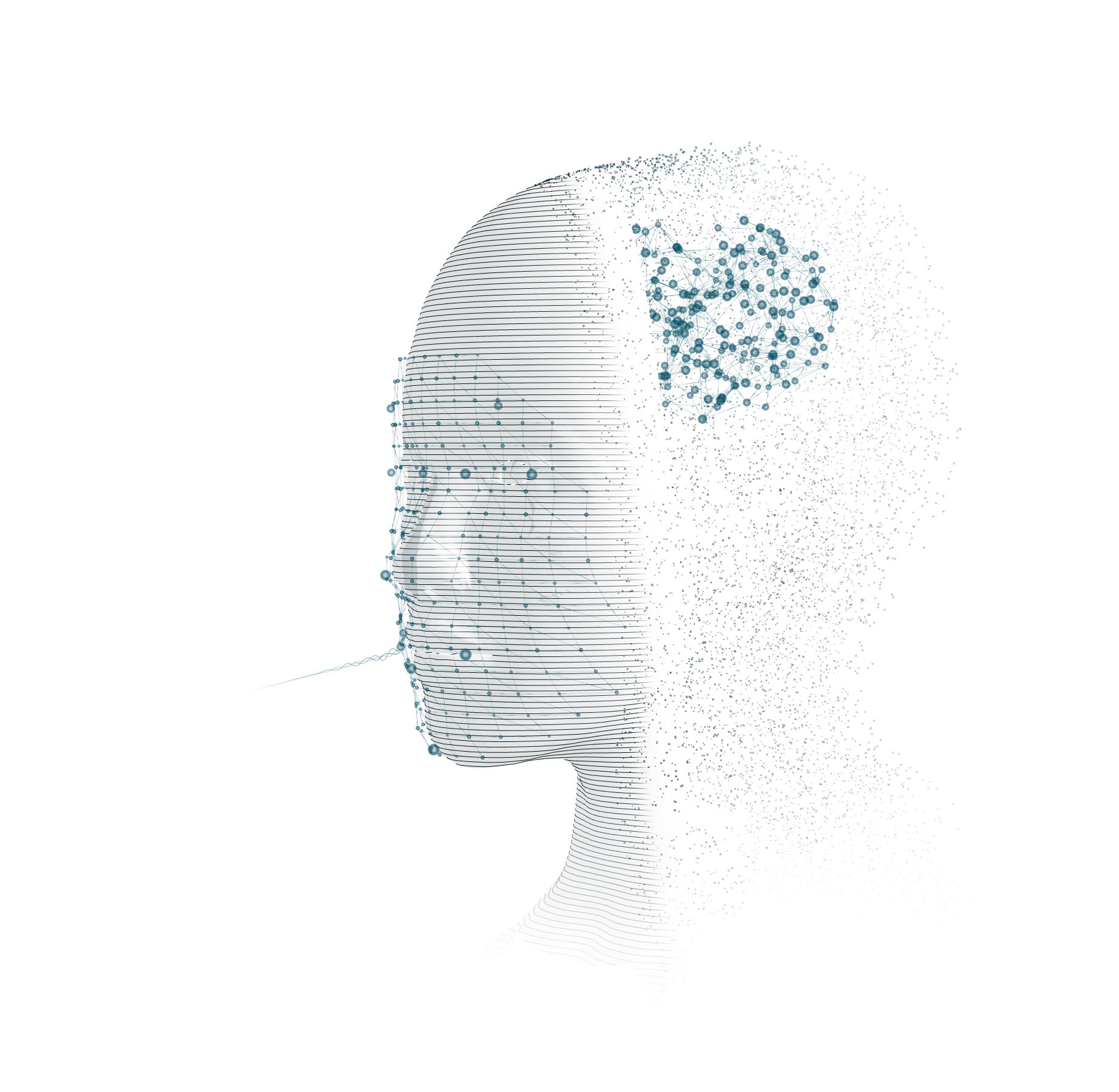
Virtual Humans that look, speak, move and think like a real person — so one person can hold countless conversations at once, in any language, anywhere.
What if the people who matter most could always be there — to teach, to heal, to talk?
FUTELLA builds Virtual Humans that carry a person’s identity: how they look, how they sound, how they react and how they think. Not an avatar reading a script, but a presence you can hold a real conversation with — in any language, at any hour, and with countless people at the same time.
02Core engine
Four layers of a human, replicated as one.
Every FUTELLA Virtual Human is assembled from four coupled models. Each is captured from real data, and each informs the others — so the face moves the way the voice feels, and the words sound like the mind behind them.
01 / 04
01
Appearance
Face · skin · micro-expression
High-fidelity facial geometry and texture, reconstructed from ordinary video and rendered in real time.
02
Voice
Timbre · prosody · accent
A voice model that keeps the person’s timbre and rhythm, speaking fluently in every language.
03
Behavior
Expression · gesture · timing
Learned patterns of expression and gesture, so reactions arrive with the right emotion at the right moment.
04
Mind
Memory · reasoning · personality
A persona model grounded in the person’s knowledge, values and way of thinking — consistent across every conversation.
From a person to a presence
Capture
Consented video, voice and text from the person — or a designed identity.
Model
Appearance, voice, behavior and mind are trained as one coupled system.
Persona
Identity, boundaries and memory are verified with the person or their representatives.
Deploy
Live video conversation, education platforms, clinics and social channels.
Real-time video conversation
Face-to-face dialogue with natural turn-taking, like a video call.
Every language
One identity, fluent across languages and cultures.
Persistent identity
Memory and personality that stay coherent over months, not minutes.
Unlimited concurrency
One person, in thousands of simultaneous conversations.
03Applications
One Virtual Human. Three worlds.
The same engine powers three markets. A person replicated once can heal, teach and reach the world — and every deployment strengthens the core.
Virtual Human Creation
01Digital Medicine & Therapy
02Education for the AI Generation
03Digital Persona Marketing
01 / 03
Digital Medicine & Therapy
A clinically guided reunion — to say what was left unsaid.
With university hospitals and psychiatrists
Losing someone suddenly — to an accident, an illness or a disaster — often leaves words unsaid and goodbyes that never happened. FUTELLA faithfully reconstructs the person who was lost — their face, voice, way of speaking and way of thinking — from the photos, videos, recordings and messages a family chooses to share. In sessions guided by a psychiatrist, the bereaved can see and speak with them again, work through what was left unfinished, and say goodbye. We are developing this as a digital therapeutic for grief, depression and prolonged grief disorder, together with university hospitals and psychiatrists.
Why it matters
1 in 10
bereaved adults develops prolonged grief disorder — now a recognised diagnosis in ICD-11 and DSM-5-TR. [1][2]
How it works
01PrepareClinical assessment and family consent. The persona is built only from material the family chooses to share.
02ReuniteA therapist-guided encounter: seeing, hearing and talking with the person again in a safe, structured setting.
03IntegrateUnfinished conversations, memories and meaning are worked through with the clinician.
04FarewellA planned ending that supports a lasting inner bond — not dependence on the replica.
Evidence
Continuing-bonds research shows that healthy grief often maintains, rather than severs, a connection with the person who died. [3]
Imaginal conversation with the deceased is a core technique of complicated grief treatment, which nearly doubled response rates over standard psychotherapy (51% vs 28%) in a randomised trial. [4]
02 / 03
Education for the AI Generation
The world’s best teachers, one-to-one, for every student.
With universities and professors
Great teaching has always been scarce: a renowned professor can only be in one room, in one language, at one time. With their consent, FUTELLA replicates professors, researchers and mentors — their knowledge, their way of explaining and their presence — as AI faculty who can tutor any number of students individually, around the clock and in every language. Built with universities and professors, and centred on project-based, problem-solving learning rather than memorisation.
Why it matters
2σ
Students tutored one-to-one perform about two standard deviations above classroom peers — the “2 sigma problem”. [5]
How it works
01CaptureLectures, writing and conversations of the educator, under licence and consent.
02ModelTheir expertise, reasoning and teaching voice become an AI faculty member.
03TeachOne-to-one Socratic tutoring and project coaching for every student, in their own language.
04ReviewProfessors review, correct and update their replica; universities keep academic control.
Evidence
In a Harvard randomised controlled trial, students taught by an AI tutor achieved learning gains more than double those of an active-learning class. [7]
A landmark review found intelligent tutoring systems nearly as effective as human tutors (effect size 0.76 vs 0.79). [6]
03 / 03
Digital Persona Marketing
One persona. Every language. Millions of conversations at once.
With brand and platform partners
A person can only be on one call, in one language, at a time. A FUTELLA persona speaks every language in its own voice — so a brand, a creator or an expert can enter any market from day one, with no language barrier. It holds countless one-to-one conversations at the same time across social platforms, live commerce and customer channels, always consistent in character, day and night.
Why it matters
1 : ∞
One persona holds any number of simultaneous one-to-one conversations — in every language, in every market.
How it works
01CreateA licensed replica of a real person, or an original persona designed for the brand.
02LocaliseThe same face and voice, fluent in every language and adapted to every culture.
03EngageMillions of simultaneous one-to-one conversations across social, commerce and service channels.
04LearnEvery conversation returns insight to the brand, market by market.
Evidence
AI is progressively taking over service work — from mechanical and analytical tasks to the intuitive and empathetic interactions that shape customer relationships. [8]
Leading marketing research expects AI to transform how brands engage customers, from one-to-one conversations to entire market strategies. [9]
References +
Lundorff M, Holmgren H, Zachariae R, Farver-Vestergaard I, O’Connor M. Prevalence of prolonged grief disorder in adult bereavement: a systematic review and meta-analysis. J Affect Disord. 2017;212:138–149.
Prigerson HG, Horowitz MJ, Jacobs SC, et al. Prolonged grief disorder: psychometric validation of criteria proposed for DSM-V and ICD-11. PLoS Med. 2009;6(8):e1000121.
Klass D, Silverman PR, Nickman SL, eds. Continuing Bonds: New Understandings of Grief. Taylor & Francis; 1996.
Shear K, Frank E, Houck PR, Reynolds CF. Treatment of complicated grief: a randomized controlled trial. JAMA. 2005;293(21):2601–2608.
Bloom BS. The 2 sigma problem: the search for methods of group instruction as effective as one-to-one tutoring. Educational Researcher. 1984;13(6):4–16.
VanLehn K. The relative effectiveness of human tutoring, intelligent tutoring systems, and other tutoring systems. Educational Psychologist. 2011;46(4):197–221.
Kestin G, Miller K, Klales A, et al. AI tutoring outperforms in-class active learning: an RCT. Sci Rep. 2025;15:17458.
Huang MH, Rust RT. Artificial intelligence in service. Journal of Service Research. 2018;21(2):155–172.
Davenport T, Guha A, Grewal D, Bressgott T. How artificial intelligence will change the future of marketing. J Acad Mark Sci. 2020;48:24–42.
Hollanek T, Nowaczyk-Basińska K. Griefbots, deadbots, postmortem avatars: on responsible applications of generative AI in the digital afterlife industry. Philos Technol. 2024.
04Experience
A conversation, not a recording.
A FUTELLA Virtual Human listens, remembers and responds in the moment. It looks you in the eye, reacts to what you say, and speaks in a voice you recognize.
Live
Real-time video dialogue with sub-second responses.
Multilingual
Speak in your language; hear the same familiar voice.
Contextual
Remembers what matters from one conversation to the next.
At scale
The same person, in thousands of conversations at once.
OriginalVirtual Human
05Ethics
Replicating a person is an ethical act before it is a technical one.
Our work touches identity, memory and grief. We hold ourselves to standards stricter than the law requires — shaped by clinicians and by the growing research on digital afterlife technologies.
01
Consent and ownership
A real person is replicated only with their consent or that of their lawful representatives. A persona belongs to the person it represents — never to us.
02
Dignity of the deceased
Reconstructing someone who has died requires the family’s consent, is used only in clinical settings, and is never used for advertising or entertainment.
03
Clinical oversight
Therapeutic use is designed, delivered and reviewed by licensed psychiatrists, with safeguards against over-reliance and a planned ending.
04
Transparency
A FUTELLA Virtual Human always discloses that it is an AI. No one should ever be led to believe they are speaking with a human.
05
No impersonation or misuse
We refuse deceptive uses — political manipulation, fraud, non-consensual likenesses and deepfakes.
06
Privacy and the right to retire
Identity data is encrypted, minimally collected and deletable. Every persona can be retired, respectfully, at the request of those it belongs to.
Clinical studies are conducted with our university hospital partners under institutional review board (IRB) oversight.
Led by a scientist who works across medicine and computation.
Founder & CEO
Do-Hyeon Kim, Ph.D.
Dr. Kim’s work sits where biology, medicine and computation meet — from single-molecule imaging inside living cells to building production AI systems. Dr. Kim founded FUTELLA to bring scientific rigor to the replication of human identity.